Let’s be honest: most of us have received a promotional pen that gave up before the meeting started.
Or a tote bag so flimsy it couldn’t carry a sandwich. Or a stress ball shaped like something nobody asked for, sitting sadly in a desk drawer until moving day.
So, are generic giveaways dead?
Not quite. But they’re certainly on life support.
People still keep branded merchandise. They still wear it, use it, talk about it and occasionally fight over the last decent item at an event. The difference is that nobody wants another bit of cheap, forgettable stuff with a logo slapped on it.
People keep things that are useful, well made and feel like they belong to a real brand.
That’s the bit many companies miss.
Generic isn’t the same as branded
A product can have your logo on it without saying anything meaningful about your business.
That’s the difference between branded merchandise and generic promotional products.
Generic merchandise starts with the item. A pen. A mug. A USB stick. A notebook. Whatever’s cheapest and available before Friday.
Proper branded merchandise starts somewhere else:
- Who are you?
- Who are you giving this to?
- What do you want them to feel?
- What would they actually use?
- What makes your brand recognisable beyond a logo?
It’s a small change in thinking, but it completely changes the result.
A premium coffee brand might create a beautifully designed travel cup that feels at home in someone’s morning routine. A creative agency might produce a limited-run garment people genuinely want to wear. A restaurant group might develop packaging, clothing or accessories that become part of the customer experience.
Same basic principle. Different level of thought.
And that thought matters. According to PPAI’s 2025 consumer research, 68% of people say they keep promotional products because they’ll actually use them, while 68% point to high-quality materials as a reason to hold on to them.
In other words: make it useful. Make it good. Don’t make it look like it was ordered by someone who has never met another human being.
Do people still keep branded merchandise?
Yes. Absolutely.
But they don’t keep it because it’s technically free. Free rubbish is still rubbish.
They keep it because it earns a place in their life.
That could mean:
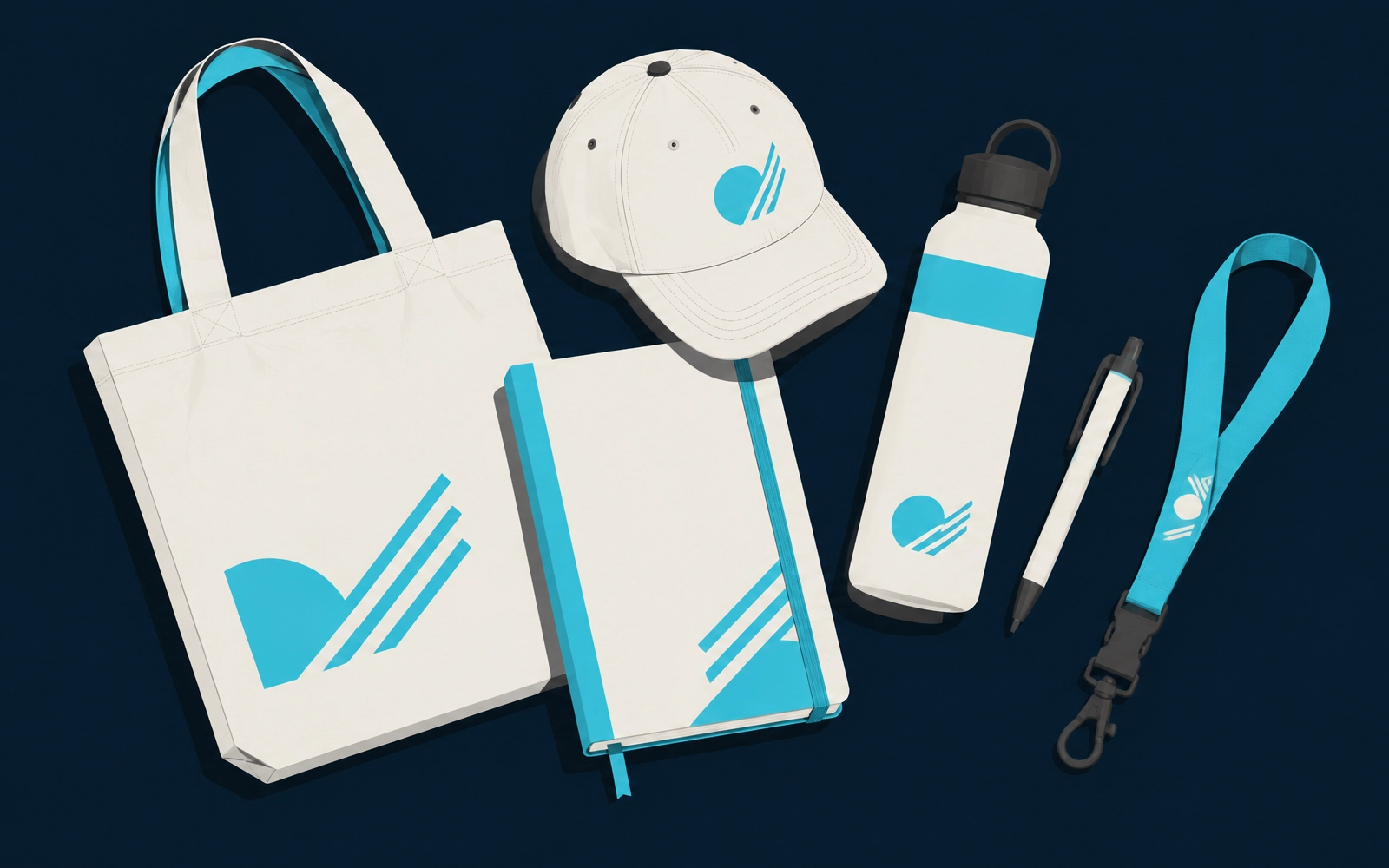
- A notebook they use in every client meeting
- A decent bag they take to work
- A cap that looks better than the one they bought last summer
- A travel mug that doesn’t leak all over their laptop
- A sweatshirt they actually choose to wear
- A clever desk accessory that solves an everyday irritation
- A beautifully made item connected to a memorable event
The research backs this up. PPAI found that 61% of recipients remember the brand from their most recent promotional product, while 77% looked up the brand afterwards.
That’s a fair bit more useful than a logo disappearing into the bottom of a conference goodie bag.
The point isn’t to give people more things. Most people already have enough things. The point is to give them the right thing.
Quality is no longer optional
There was a time when a cheap giveaway could sneak past people because, well, it was free.
That time has gone.
People are more aware of quality now. They notice flimsy fabric. They notice poor printing. They notice when a supposedly “premium” gift feels like it was manufactured in a cupboard behind a motorway service station.
And the awkward truth is this: the item reflects back on your brand.
A poorly made giveaway doesn’t just get ignored. It can make people assume the same lack of care applies to your products, your service or your business.
PPAI’s research found that poor material or build quality was the biggest reason promotional products felt cheap or forgettable. Boring design came next.
That makes sense. If the product feels cheap, your brand ends up wearing the cheapness. Not ideal.
Good promotional merchandise doesn’t have to be wildly expensive. It does need to be considered. The material, finish, shape, colour, packaging and decoration should all feel like they’ve been chosen for a reason.
Because they have.
The best corporate merch ideas feel like your brand
Here’s where things get interesting.
The best corporate merch ideas aren’t always the most complicated. They’re the ones that make sense for the business behind them.
A bold, playful company probably shouldn’t hand out a beige notebook with a tiny logo tucked into the corner. A luxury brand may not want to distribute a plastic keyring that looks like it came free with a cereal box.
And a sustainability-focused company probably needs to think very carefully before ordering 10,000 disposable plastic items. That one rather gives the game away.
Your merchandise should behave like an extension of your brand.
That might mean:
- Using your visual identity in an unexpected way
- Choosing materials that support your values
- Turning a familiar item into something more distinctive
- Adding a message, story or detail people want to discover
- Creating a design that works without shouting your name
- Making a limited edition item rather than a mass-produced afterthought
Subtle branding can be particularly effective. PPAI found that 44% of recipients prefer subtle branding, and 89% say design influences whether they keep a promotional product.
The logo still matters. It just doesn’t need to be the size of a dinner plate.
Unique promotional merchandise gives people a reason to remember you
There’s a temptation to play it safe with promotional products.
You know the thinking: “Everyone likes a pen.” Do they? Or do they simply tolerate pens because modern society requires writing things down occasionally?
Safe can be sensible, but safe can also be invisible.
Unique promotional merchandise gives people something to talk about. It creates a moment. It makes the item feel chosen rather than churned out.
That doesn’t mean every product needs to be bizarre. We’re not suggesting you hand out branded inflatable trousers at a financial services conference. Although, frankly, we’d remember that.
It means looking for a better fit between product and brand.
We’ve worked with everything from everyday stationery and clothing to more unusual pieces involving 3D embroidery and augmented paper. The technology or decoration isn’t the main point. The point is that the product gives someone a reason to look twice.
Then use it.
Then remember where it came from.
Creative promotional items should solve a real problem
A good promotional product doesn’t need to shout, “This is marketing!”
It can simply make someone’s day slightly easier.
That’s why practical items continue to work so well. They’re already built into people’s routines. Every time the item is used, your brand gets another quiet appearance.
Not a dramatic advertising moment. More like a reliable supporting actor who keeps turning up and never ruins the scene.
Before choosing an item, ask:
- Will the recipient use this more than once?
- Does it suit their work, lifestyle or interests?
- Is it good enough to keep alongside the things they already own?
- Does it look and feel like our brand?
- Would we be happy to give this to someone without our logo on it?
That last question is useful.
If the answer is no, you’ve probably got a product problem.
The strongest creative promotional items often pass the “logo removed” test. They’d still be useful, attractive or interesting without the branding. Your logo adds recognition; it doesn’t have to do all the heavy lifting.
So, are generic giveaways dead?
The generic giveaway isn’t completely dead. There are still situations where a simple, low-cost item makes sense. Particularly when you need high volumes for a large event.
But it shouldn’t be the default.
If you’re handing out thousands of items, you still need to think about whether those items will be used, recycled, passed on or binned before the recipient reaches the car park. More isn’t automatically better. Sometimes it’s just more rubbish.
The old approach was:
Put the logo on something cheap and distribute as many as possible.
The better approach is:
Understand the audience, choose something useful, make it properly and give people a reason to keep it.
That’s the difference between merchandise and clutter.
At The Brand Masters, we do more than take your logo and stick it on the nearest catalogue product. We’ll help you find something that feels like you, whether that’s a refined piece of stationery, a hard-working bag, distinctive clothing or something a bit more unexpected.
We’re not precious about it. Some projects are simple. Some get gloriously weird. The important thing is that the end result makes sense for your brand and doesn’t end up sulking in a drawer.
So yes, people still keep branded merchandise.
They just expect a bit more from it now.
Make it useful. Make it distinctive. Make it properly yours.
Then people won’t need persuading to keep it.